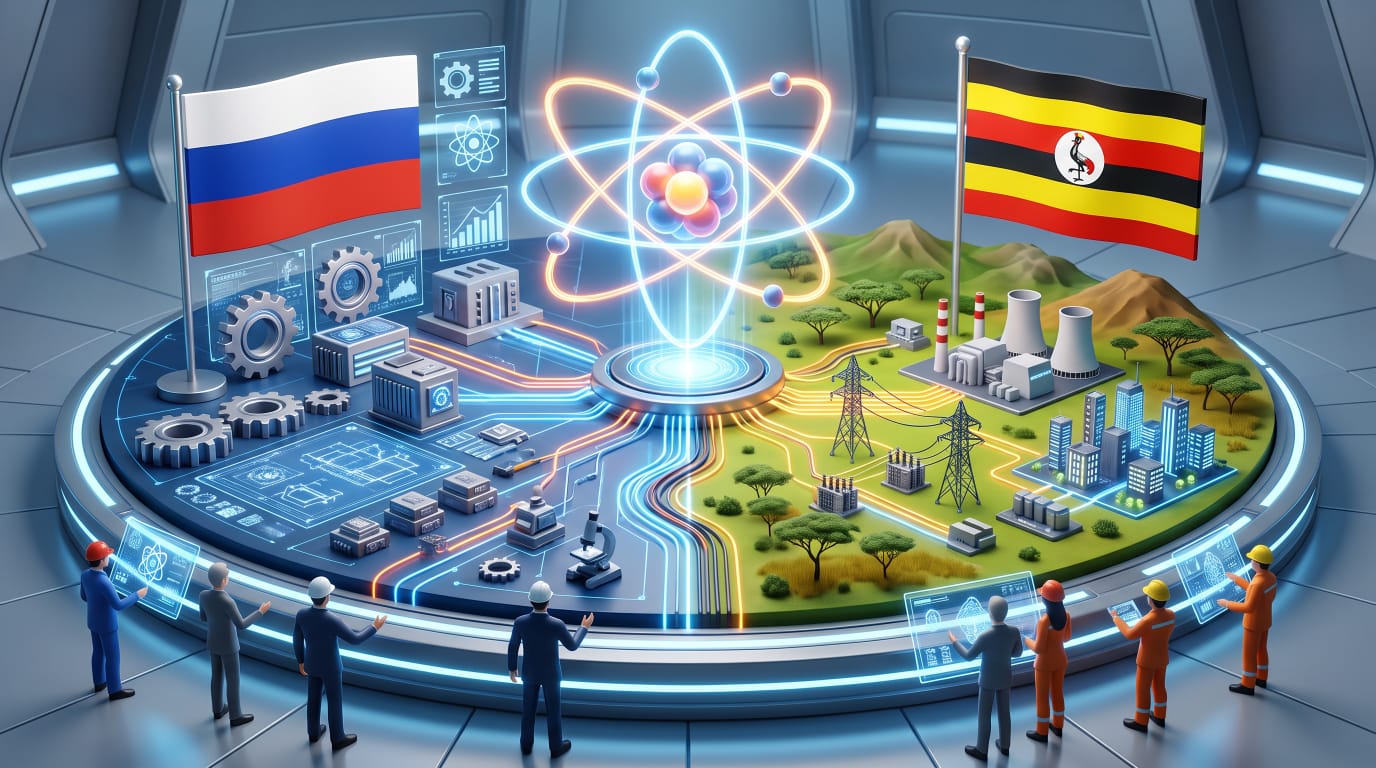
The senior energy specialist in the Nuclear Energy Department of the Ministry of Energy and Mineral Resources of Uganda, Damalia Noel Abbo Ofumbe, has revealed that the country is seeking to partner with the Republic of Russia in areas of Energy, digital technologies, artificial intelligence and independent payment systems.
“Since 2007 we have faced a number of problems, such as drought on the Nile River, so we had to revise our energy balance. We are developing hydro and solar energy, but we also need other sources. That is how the need arose for nuclear energy,” she said.
Ms Ofumbe made the remarks during a round table dedicated to Russian-Ugandan cooperation held in Kampala on Wednesday, ahead of the third Russia–Africa summit, which will take place on October 28–29, 2026 in Moscow.
She noted that according to the country’s 2023 Energy Policy, by 2040 the country should generate 52,000 megawatts of electricity, of which about 24,000 MW are planned to come from nuclear energy.
She noted that potential sites for a nuclear power plant have already been selected including Buende, Nakasongola, Lamu and Kihura.
Ofumbe revealed that negotiations are currently underway with Rosatom, and a site assessment in Nakasongola is planned for the project which envisages the construction of a 7,200 MW station — six reactors using Russian technology, each about 1,200 MW.
“We recently signed a roadmap for this project,” she said.
Ofumbe recalled that a memorandum of understanding with Russia was signed in 2017, and in 2019 in Vienna, an intergovernmental agreement.
“The feasibility study is planned to be completed by 2030, and the first unit may be launched by 2035–2038” she said.
She further reiterated that nuclear energy is not only electricity, while further calling for knowledge transfer as the most important aspect.
“We are already implementing projects for the diagnosis and treatment of cancer at the Uganda Cancer Institute, and we are working on food safety and the diagnosis of animal diseases, such as foot-and-mouth disease” she said.
She added, “The station will operate for 100 years, and Ugandans must be able to independently manage and maintain it”.
The Chargé d’Affaires ad interim of Russia in Uganda Sergey Lobanov, recalled that diplomatic relations between the USSR and Uganda were established on October 13, 1962, and that the sides would soon mark the 64th anniversary.
“We were one of the first powers to recognize the sovereignty and independence of Uganda” he said.
Lobanov noted that interaction between the Rosatom state corporation and the Ugandan Ministry of Energy and expressed hope that projects in the field of peaceful uses of atomic energy would be implemented in the country in the near future.
“At the end of this month, the third Russia–Africa summit will be held in Russia. We hope that its results will make it possible to raise bilateral relations to new heights in the sphere of energy, trade, the economy, science and technology” he said.
Lobanov further called for holding of such talks more often in order to reveal the development potential of both country’s relations, “Make them mutually beneficial and begin a new era of cooperation between Russia and Uganda,” he said.
The deputy executive director of the Southern and Eastern Africa Trade Information and Negotiations Institute (SEATINI) Herbert Kafiro, noted that energy is a matter of national economic security and industrial policy.
“Uganda dreams of a $500 billion economy, and this is impossible without industrialization, which, in turn, is impossible without energy,” he said.
Kafiro said nuclear energy must be introduced wisely to not only support electrification, but also be used in agriculture and healthcare, while also pointing out the trade deficit with Russia explaining that Uganda spends a lot of funds on imports of machinery and wheat, and earns mainly from exports of raw materials from coffee and tea.
“We need to negotiate the export of value-added goods. By exporting raw materials, we export jobs” he said.
He further called for deeper negotiations and a “whole-of-government” approach, involving farmers, the Ministry of Trade and the Ministry of Agriculture.
The Chief Research Fellow at the Center for Transition Economy Studies of the Institute of Africa of the Russian Academy of Sciences, Denis Degteev noted that at the upcoming Russia–Africa summit the focus would shift from simple trade cooperation, the volume of which amounts to $27 billion, to full-scale long-term production cooperation.
He pointed out that the launch of the El-Dabaa nuclear power plant in Egypt the most important step.
“In essence, Russia is breaking a long-standing taboo on the development of nuclear energy on the African continent. Atomic energy gives an enormous impetus to electricity generation, which is vital for the industrialization of Africa” he said.
Degteev called upon regional integration within the framework of the East African Community, noting that countries in the region are rich in oil and gas, but import almost all petroleum products. “We hope that the oil extracted in Uganda will be processed locally and exported to neighboring countries. Russia is ready to participate in the development of regional energy projects,” he said.