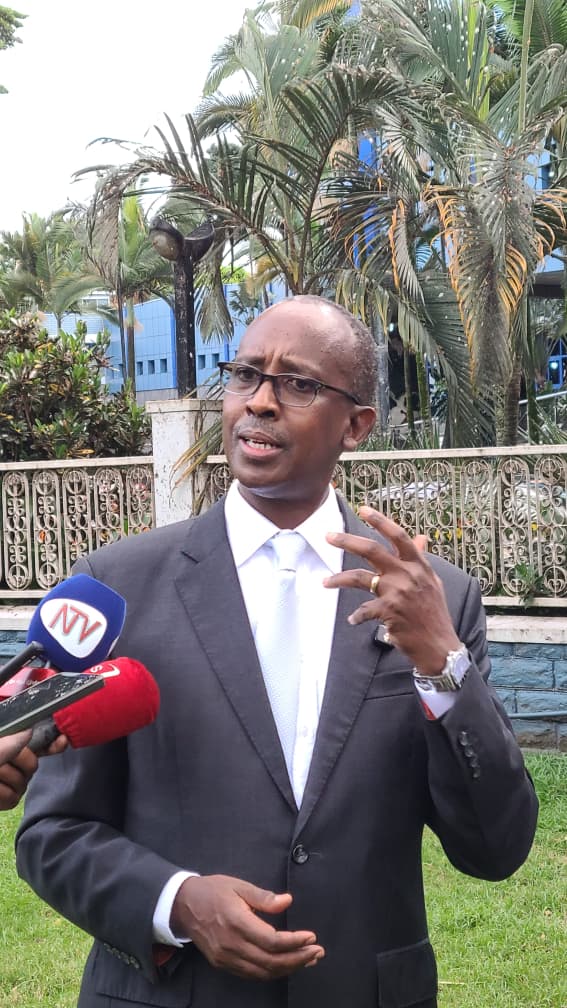
The Chairperson of the Presidential Advisory Committee on Export and Industrial Development (PACEID) Odrek Rwabwogo, has urged for a measured stand to be taken by all stakeholders on the proposed Sovereignty Bill 2026.
While addressing journalists on the side lines of the second phase of a four-day PACEID Hospitality Impression Training in Entebbe on Wednesday, Rwabwogo urged that areas that undermine Uganda’s gains in economy and democracy should be removed but warned that placing restrictions on capital, will affect the much needed Foreign Direct Investment into the country.
“We have experienced that more freedom in economy is more investment sometimes it can appear like anarchy because everybody is in, but you’d rather have less restrictions than adding more so where there are problems we should deal with them” he said.
He however warned of denouncing the Bill off in an “omnibus way”, which says government has intelligence information over time that there is an attempt to influence the integrity and dignity of Uganda’s processes either financially or democratically.
“Look at this in a very centred way and read the bill and have your comments as media, as I have seen many institutions, I’ve seen central bank, i’ve seen the lawyers that’s democracy, we shouldn’t hide the ideas coming from government but we shouldn’t just take them because they have come from government we must arrive at a middle ground that allows us to keep growing without putting restrictions on trade” he said.
Rwabwogo, who is also a Senior Special Advisor to President Yoweri Museveni, and son in law to the first family, further warned that placing restrictions on capital, noting that this would weaken the economy and called for the country at large to take a measured stand on the Bill.
“Capital is so fragile, any smell that something is wrong anything that I invited into my house now i’m closing windows, is very dangerous for the other person who is not in the house and we want to bring in more FDI (Foreign Direct Investment) so let’s take a measured stand on this” he said.
The controversial Bill has met stiff resistance from the Bank of Uganda, World Bank, members of the opposition and civil society, and general public across the country.
While appearing before the Joint Committee on Defence and Internal Affairs and Legal and Parliamentary Affairs on Tuesday, the Governor of the Bank of Uganda, Michael Atingi-Ego, warned that the proposed Protection of Sovereignty Bill 2026, could disrupt the country’s financial stability, restrict foreign investment, remittances and further undermine the country’s long-term economic ambitions.
“Chairman, a country without reserves is not sovereign. The potential of this Bill to destabilize Uganda’s balance of payments is our primary concern as a central bank. For example, last financial year the overall balance of payment surplus was USD 1.5 billion That’s how we were able to increase our reserve coverage by USD 1.5 billion” he said.
Atingi further warned that classifying such inflows as “foreign agency” could disrupt household incomes and weaken foreign exchange liquidity, placing pressure on the shilling.
However the State Minister for Finance Amos Lugoloobi, in a Certificate of Financial Implications submitted to Parliament, said the bill will strengthen national control by regulating foreign influence and aligning external financing with Uganda’s development priorities.
“The proposed Bill is expected to strengthen Uganda’s policy autonomy and national security architecture, improve coherence in the management of foreign aid and foreign-funded activities, and support stability in governance and public order” he said.
Minister Lugoloobi further noted that the bill is not anticipated to directly generate revenue to Government and is primarily intended to strengthen Uganda’s legal and institutional framework for the protection of sovereignty and related enforcement mechanisms.