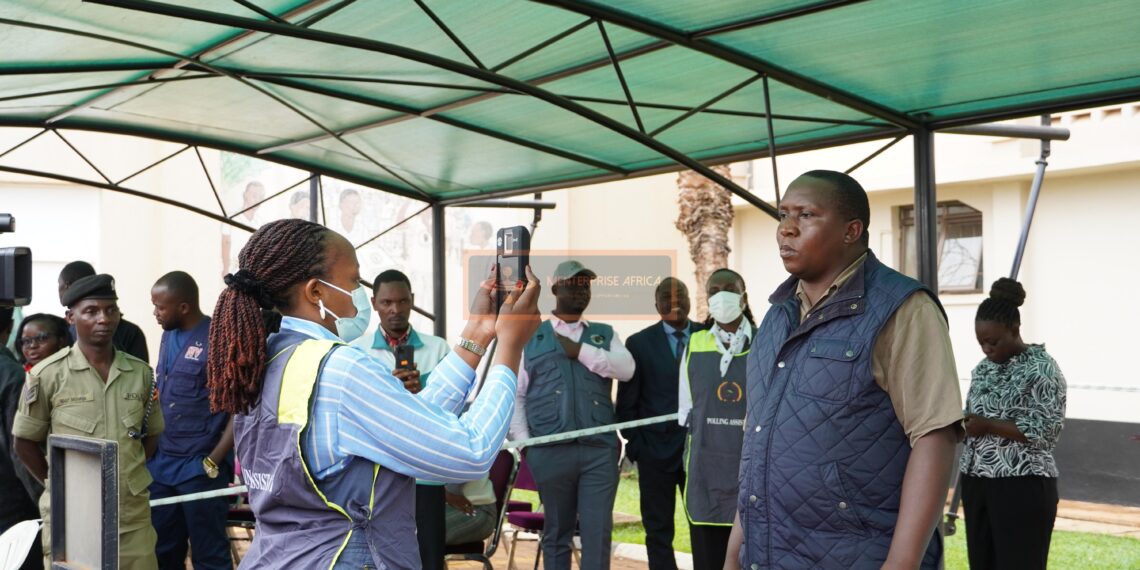
In a bid to calm the public’s fears of Ugandans querying the efficiency of the biometric machines, the EC organised a mock public demonstration at its headquarters on Seventh Street in the Kampala City Industrial Area on December 17, 2025, to show how the BVVK system will work during the forthcoming presidential and parliamentary elections.
The EC technical team took charge of the mock demonstration while other Commission officials chipped in from time to time to explain the theoretical workings of BVVK.
The EC deputy chairperson, Aisha Lubega, reassured the public that the machines will ensure the one-vote principle is adhered to to the letter.
“The system will ensure that only registered voters vote during elections and that such persons do not vote more than once, for the same election, hence helping the Commission achieve a one-man, one-woman vote principle,” she said.
On his part, the EC spokesperson, Julius Mucunguzi, added that the biometric machines will subsequently eliminate the possibility of imported ballot papers, as any found will be rejected by them.
The machines verify both the voter and ballot papers used during the voting process.
There are 109,142 biometric machines to be deployed at 50,739 polling stations countrywide during the 2026 presidential and parliamentary elections. The national voters’ register, on the other hand, has about 21.6 million voters. However, the EC says the machines are sufficient since they verify each voter and ballot within 30 to 60 seconds.
How the BVVK Works
A singular biometric voter machine comprises the equipment used at the polling stations and the central management system managed by EC staff outside the polling stations.
On voting day, January 15, 2026, the process will commence by assigning biometric machines to designated polling stations, which will be done by scanning the Quick Response (QR) code on the voters’ register. Then, the specifics of the polling station will appear on the biometric machine.
The BVVK operator [who will support the verification of voters] and the polling station’s presiding officer will scan their original National Identification Card (IDs) or Voter Location Slips (VLS) before verifying either their fingerprints or facial features, a process required to be able to log into the machine.
The next stage will involve scanning each QR code on the ballot paper booklets for the categories of President, Member of Parliament (MP), and District Woman Member of Parliament.
“Scanning enables the machine to recognise that these ballot papers are of [that designated] polling station,” said Solomon Muhumuza, the director of technical services at the EC, during the demonstration.
This procedure will be followed by verification of the ten witnesses who observe and approve the start of the voting process, as required by law. The witnesses, who are voters themselves, will be verified by a BVVK operator who will scan their voter’s National ID, or VLS, or scan the QR Code against their name on the voters’ register.
Once their details match those of the designated polling station, the witnesses cast their votes, followed by other registered voters waiting.
“It is still the same process. The BVVK operator will scan the voter’s National ID, or VLS, or scan the QR Code against their name on the national voters’ register,” Mr Muhumuza said.
If the confirmation process is successful, the machine’s automated voice says, “success.” The voter will subsequently be given three ballot papers to cast their vote to choose their preferred leaders [President, MP, and District Woman MP]
Once all the polling processes have been concluded, Mr Muhumuza said they will scan all the ballot papers that were cast.
“This is to identify if there are any ballot papers that would have come in and we are not aware of,” Muhumuza said while elaborating that the biometric machine easily identifies foreign ballot papers and alerts a BVVK operator of its existence.
Solomon Muhumuza, the director of technical services at the Electoral Commission, explains how the BVVK system works.
Verifying each voter using the biometric machine takes about a minute, Mr Muhumuza said, adding that every polling station will have two biometric machines with their respective power banks.
“These do not need internet [to work],” he said, as a response to worried voters who have always questioned how the machines will work in case there is an internet interruption on election day.
To ensure that the machines work seamlessly by ensuring that every voter goes through the process, the Commission said it has averaged all polling stations to about 600 voters, who will vote from 7 am to 4 pm.
Voters have been urged to find out their polling stations before voting day, as the BVVK machine will reject their credentials at undesignated locations, with the affected individuals getting turned away. The BVVK machine, EC officials said, will help some of these affected parties locate their rightful voting polling stations.