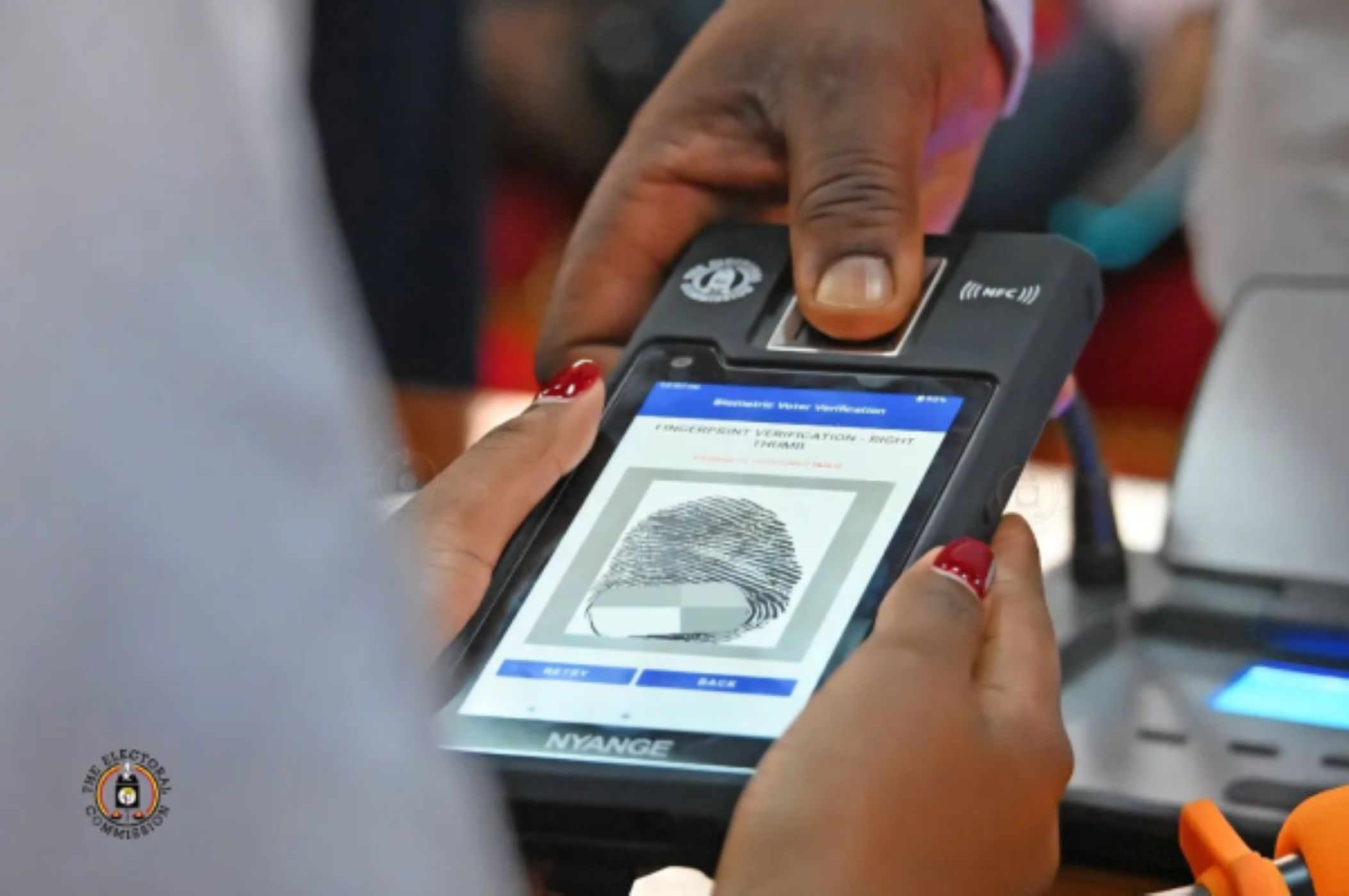
With only a few days left to polling day, the Uganda Electoral Commission has shared a brief details on how the Biometric Voter Verification Kits (BVVK), that are to be deployed on polling day will operate.
Step 1: The biometric machines will be assigned to the polling station by scanning the QR code of the national voters’ register.
Step 2: The BVVK operator and presiding officer will scan their original National IDs or VLS before verifying their fingerprints or facial features, a process that is mandatory so that they can access and use the biometric machines.
Step 3: The BVVK operator will then scan each ballot paper booklet’s QR code to identify the categories to be voted on at the polling station. This is important so that the machine recognises the ballot papers during the voting process.
Step 4: The operators then proceed to assign the 10 witnesses whose details must appear in the voters’ register. Assignment is done by scanning their original National IDs, or VLS, or scanning the QR Code against their name on the voter’s register before proceeding to take the biometrics of their fingerprints or facial features. Once the verification of witnesses is done, voting starts. Witnesses are also voters. Once their details match those of the designated polling station, the witnesses cast their votes, followed by other waiting registered voters.
Step 5: A voter is verified using their National ID, VLS, or the QR code located against their name on the voters’ register. Once this stage has been confirmed as “success” by the machine, the voter will then be given three ballot papers to cast their vote. Information of verified voters and that on scanned ballot papers is stored under different databases on the machine to ensure the secrecy of the vote. And for ruined ballot papers, they are scanned for cancellation before a voter is given another fresh one.
Step 6: A post-evaluation ballot verification is then conducted. The polling assistants will pour out the ballot papers, one category at a time. The biometric machine will be used to scan every ballot to detect any stuffed ballots, those that did not originate from a particular polling station. The other materials that will be verified, using the biometric machine, are the Results Declaration (DR) forms and the Accountability of Ballot Papers (ABP). Afterwards, the two documents are filled out, and a photograph is taken of each and uploaded to the machine, which is thereafter closed.
Step 7: Finally, the DR forms will be scanned into an Election Results Transmission and Dissemination System on EC’s private network. It will be able to transmit the results from the district tally centres to the national tally centre.