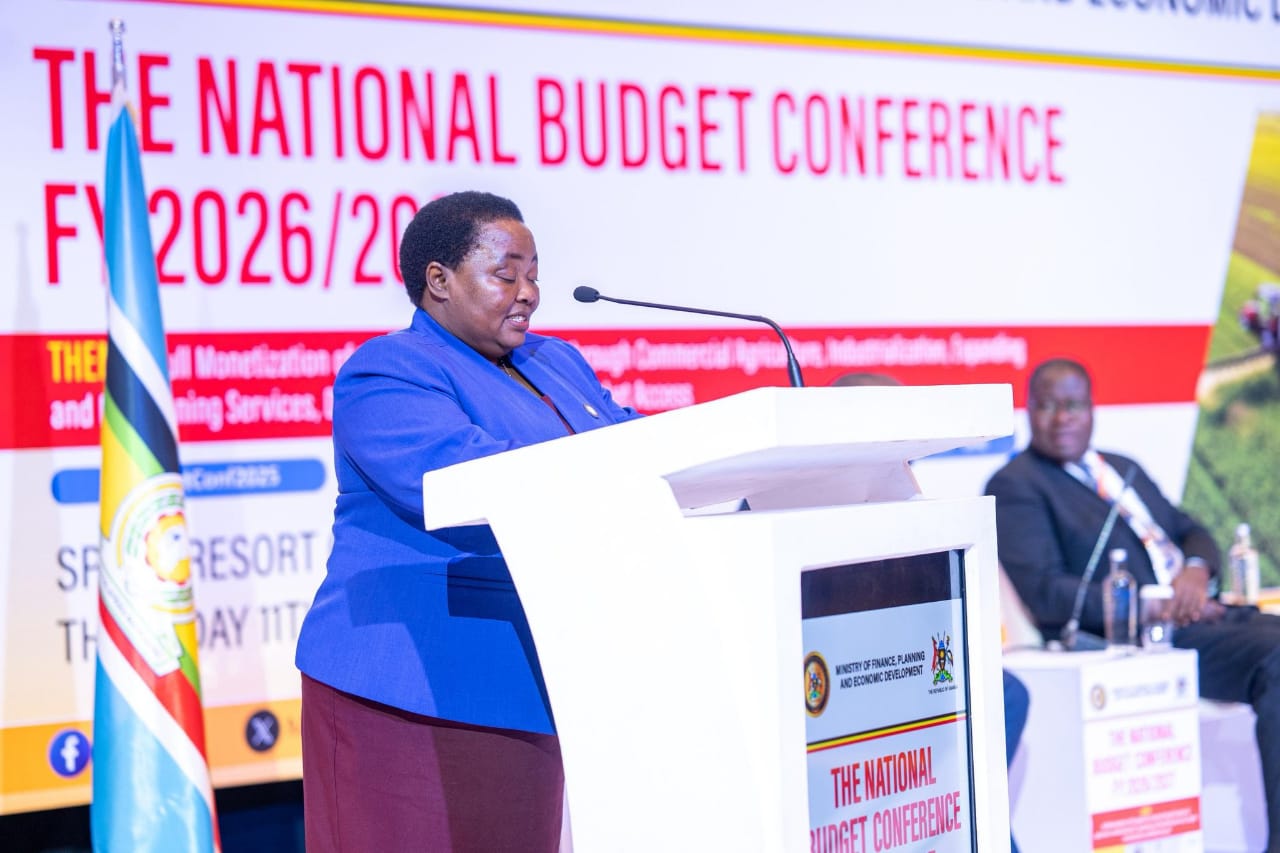
The Prime Minister Rt. Hon. Robinah Nabbanja has revealed that the new budget strategy for the financial year 2026/2027 is set to strengthen the coordination and implementation of Government programs by improving efficiency, strengthening project execution, and increasing productivity of programs to deliver more results within the available resources.
“The Budget Strategy aims at deepening the implementation of the anchor growth sectors of the Agro-Industrialization, Tourism Development, Mineral-Based Industrial Development, Science Technology and Innovation including ICT and Creative Arts Industry (ATMS) and, the Enablers” she said.
Ms Nabbanja made the remarks while opening the at the National Budget Conference for the Financial Year 2026/2027 Budget Strategy at Speke Resort and Convention Center, Munyonyo on Thursday.
“Government’s position is to deliver Uganda into the middle-income status through the Tenfold Growth Strategy of growing the economy tenfold from the base of USD 61.3 billion in FY2025/26 to USD 500 billion by the year 2040” she said
Ms Nabbanja further urged all Ministers and Accounting Officers, to ensure their priority areas for next financial year, are aligned to the ATMS and enablers in line with the NRM ideology.
“As we start the planning and budgeting process for FY 2026/27, our task is to ensure we are all committed to the efforts lifting the 33% of our population from the subsistence economy to the money economy by working through Government wealth creation programs” she said.
The Permanent secretary and secretary to the treasury Ramathan Ggoobi said the ministry has stepped up budget scrutiny and analysis to curb the challenges of Budget Games and how they negatively impact the Budget Cycle during planning, budgeting, execution, reporting, and accountability.
“Each Ministry, Local Government, Mission Abroad, Referral Hospital, Public University or Agency of Government, should plan and budget in such a way that prioritizes first, all Government of Uganda Obligations as a first call on the available resources, then statutory obligations (salaries, wages, pension and gratuity), and subsequently fixed costs (utilities, food, rent etc), and their core business/functions” he said.
Ggoobi said with such planning and budgeting, government will reduce supplementary budget requests, improve budget credibility and ultimately enhance service delivery.