President Yoweri Museveni has urged cultural leaders to concentrate on preserving heritage, promoting indigenous knowledge and advising their communities, while leaving legislation, public administration and other formal government responsibilities to the respective constitutional institutions.
Mr Museveni has further cautioned the leaders against the politicisation of cultural institutions, saying their role should remain rooted in cultural preservation, community guidance and social cohesion.
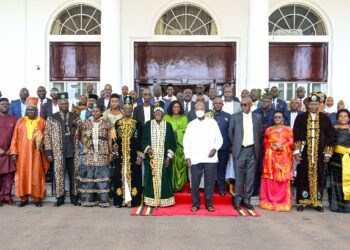
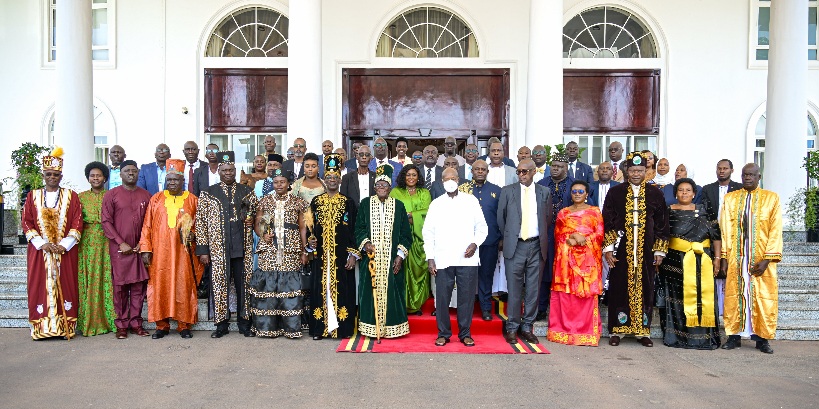
Museveni made the remarks while addressing traditional and cultural leaders on the first day of a two-day conference at State House, Entebbe on Wednesday.
President Museveni also identified the preservation and promotion of indigenous knowledge as one of the most important contributions cultural institutions can make to national development.
He cited traditional expertise in agriculture, livestock keeping, fishing, blacksmithing, carpentry, leather tanning, pottery and other forms of craftsmanship, saying such knowledge should be documented and transferred to younger generations.
He further urged cultural leaders to promote indigenous food systems, traditional crops and livestock breeds as part of efforts to strengthen food production, household incomes and economic resilience.

Museveni noted that cultural institutions have a critical responsibility to safeguard Africa’s historical identity, indigenous knowledge, languages, traditional skills and cultural practices, many of which were undermined by colonialism and its aftermath.
President Museveni said Africa’s shared history, cultural heritage and linguistic connections should be used as a foundation for strengthening cooperation, economic integration and unity among African countries.
Quoting Matthew 19:6, he said, “Therefore what God has joined together, let no man put asunder,” urging Africans to overcome artificial divisions and recognise their common heritage and shared interests.
He emphasised that cultural institutions should complement, rather than compete with, elected government structures, noting that each institution has its own distinct responsibilities.
In their presentation, cultural leaders called for stronger collaboration with the government to harness Uganda’s cultural diversity as a resource for social and economic transformation.
Through their representative, they described traditional kingdoms, chiefdoms and community-based cultural institutions as important structures for preserving national identity, promoting moral values, strengthening social cohesion and supporting reconciliation and peace.
They proposed joint programmes with the government in wealth creation, agricultural development, community industrialisation, tourism, cultural preservation, women’s economic empowerment and skills development.
Under the proposed wealth creation initiative, cultural institutions offered to provide land for model agricultural farms that would serve as centres for practical training, agricultural innovation, technology transfer, food production and agribusiness development.
The Minister of Gender, Labour and Social Development, Gen. Henry Tumukunde, urged cultural leaders to work closely with the government in addressing social challenges affecting communities.
He highlighted gender-based violence, harmful cultural practices, child marriage, teenage pregnancy, poverty, unemployment and discrimination against persons with disabilities as issues requiring collective action.