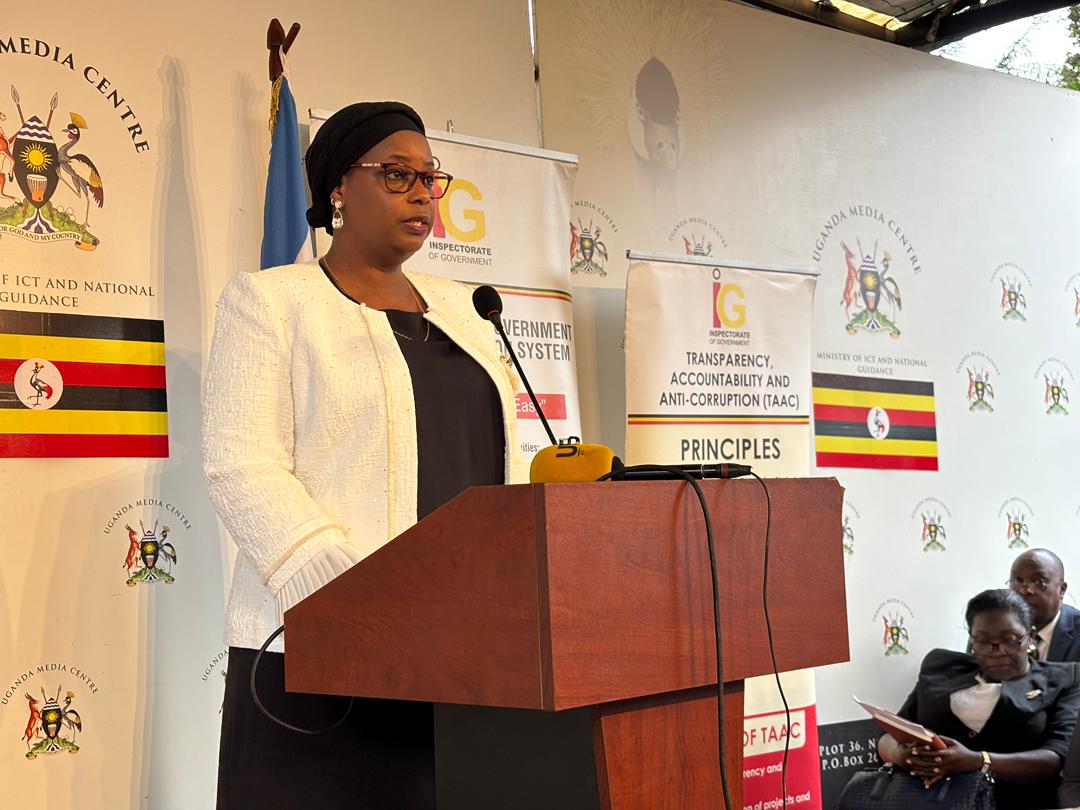
The Inspector General of Government Hon. Lady Justice Naluzze Aisha Batala, has revealed that the corruption vice in the country is no longer predominantly petty in nature but rather increasingly growing and becoming more sophisticated, with sometimes being syndicated by individuals in institutions and in certain instances linked to cross-border networks.
“At the institutional level, we face limited staffing and gaps in the specialized skills required to handle complex corruption and maladministration cases” she said.
Justice Naluzze made the remarks while addressing journalists at the Uganda Media Centre as she marked her 100 days in office as the IGG and highlighted the institutions strategic direction in the fight against corruption over the past six months.
President Yoweri Museveni appointed Justice Aisha Naluze Batala as the new Inspector General of Government (IGG) in October last year, replacing Hon. Beti Olive Namisango Kamya, whose four year term ended in the same month.
Naluzze noted that to address these challenges, the body shall be implementing targeted interventions aimed at changing public attitudes and behaviour toward corruption, while engaging Government and Development Partners to mobilize additional financial and technical support to strengthen it’s operational capacity.
“We will also continue to engage our stakeholders such as other Anti-Corruption Agencies, Civil Society Organizations, the private sector and the media to address the challenges” she said.
Justice Naluzze has revealed that in the inspectorate will continue to pursue the priorities outlined at the start of her tenure and those set out in our Strategic Plan for FY 2025/2026–2029/2030.
“In the last six months (July to December 2025), the IG registered 1,516 complaints and sanctioned 1,151 cases (75%), a total of 308 corruption cases and 330 Ombudsman matters were investigated and concluded, including 14 high-profile corruption cases” she said.
She further noted that the Inspectorate recovered UGX 2 billion in misappropriated funds, and UGX 844 million was paid to public officials who had been denied or delayed payment of their salaries, gratuity, and pensions.
Additionally, 378 out of 1,392 recommendations (27%) were implemented during the period, while 8 systemic investigations and 7 systems reviews were conducted to address structural weaknesses in public institutions.
The Inspectorate also concluded 246 breach-of-code investigations and 927 verifications, and generated 27 cases through intelligence-led operations, reinforcing the shift towards proactive enforcement
Justice Naluzze has vowed to intensify prosecution led investigations in order to combat corruption in the next six months.
“We will intensify prosecution-led investigations, with emphasis on high profile and high-impact corruption cases to strengthen deterrence. We will deepen collaboration with other Anti-Corruption Agencies to enhance coordination and ensure a more unified and effective national response” she said.
She reiterated that the inspectorate will promote a whole-of-government approach by supporting Ministries, Departments, Agencies, and Local Governments to mainstream Anti-Corruption measures into their plans, budgets, projects, and programmes.
“Our goal is not only to enforce the law but also to strengthen systems and prevent corruption before it occurs”
Justice Naluzze noted that the progress the inspectorate has made in the last six months reflects a clear shift toward results, stronger enforcement, and institutional reform.