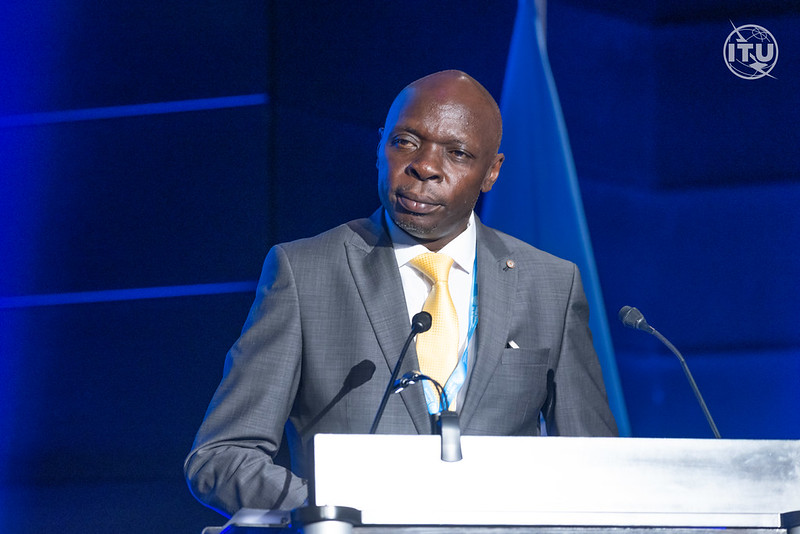
Geneva –Uganda has called for a more inclusive approach to global artificial intelligence governance, urging that developing countries must be part of shaping the rules, standards and systems that will guide the future of AI.
Minister of State for ICT and National Guidance, Hon. Alioni Yorke Odria, made the call while delivering President Yoweri Museveni’s speech, during the High-Level Governmental Plenary Segment of the United Nations Global Dialogue on AI Governance, held in Geneva, co-chaired by El Salvador and Estonia and supported by ITU, UNESCO and other UN partners.
Hon Odria, reaffirmed Uganda’s commitment to responsible AI governance that advances sustainable development, supports inclusive digital transformation, and reflects the priorities of developing countries.
“Uganda does not come to this Dialogue to receive policies and guidelines written for us by others. We come to help write them,” he said.
Hon. Odria said Uganda approaches artificial intelligence not with anxiety, but with a clear national development plan, with the country’s ambition to grow its economy tenfold to USD 500 billion by 2040, driven by agro-industrialisation, tourism, minerals, and science, technology and innovation.
“Artificial intelligence has a direct role to play in this transformation, particularly in sectors that are central to Uganda’s economy and public service delivery, including agriculture, tourism, minerals, health and education” he said.
He further pointed to Uganda’s Digital Transformation Roadmap as a foundation for building the country’s digital future through infrastructure, services, data protection, skilling and innovation.
However, Uganda cautioned that the promise of AI will remain unequal unless the global community addresses the major divides in compute capacity, data and skills.
Hon. Odria observed that Africa holds less than one per cent of the world’s AI compute capacity, noting that ambitious development plans cannot be achieved on such limited access to global technological capability.
“A tenfold-growth ambition cannot run on one per cent of the world’s capability,” he said.
Hon. Odria further urged support for interoperable, standards-based approaches that avoid fragmented systems, to ensure safe, secure and trustworthy Ai, which is essential to ensure that innovations developed in countries such as Uganda can be recognised and trusted beyond national borders.
“Transparency, accountability and human oversight must remain central to AI governance, these safeguards must protect every person equally, including communities whose languages, cultures and data are still underrepresented in the development of AI systems” he said.
The Minister welcomed the first report of the Independent International Scientific Panel on AI and noted Uganda’s readiness to contribute actively to future thematic work under the Global Dialogue. “AI governance must be shaped at every level, nationally, regionally, continentally and globally, with developing countries present not only as beneficiaries but also as co-authors of the emerging international framework” he said.
He added, “Govern this technology with us, not for us. That is how a rule made in Geneva earns trust in Kampala, and how a solution built in Kampala is recognised in Geneva”.