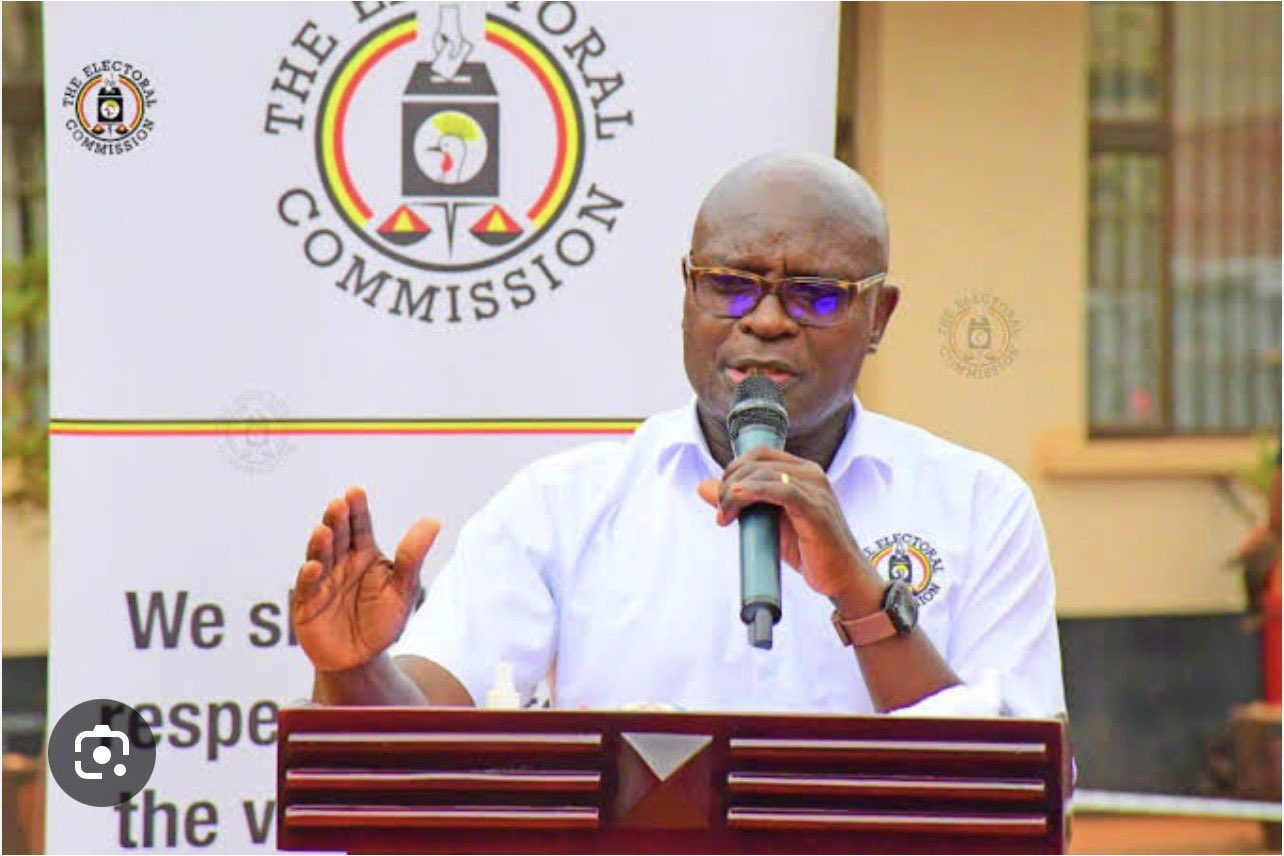
The Chairperson, Electoral Commission Justice Simon Byabakama while giving an update on the progress of the implementation of activities under the Roadmap for General Elections 2026, has revealed that the commission is set to deploy Biometric Voter Verification Kits (BVVK), to improve election management.
The Electoral Commission is empowered under the law to adopt and use technology in the Management of Elections. Specifically, S.I. No. 2 of 2021 enjoins the Commission to use technology in the electoral process.
Accordingly, the Commission has procured 109,142 Biometric Voter Verification Kits (BVVK) which will be deployed for the 2025/2026 General Elections, as a measure aimed at improving the management and conduct of elections through authentication of voter identity.
Out of these, 60,000 kits have so far been delivered and the balance of 49,142 kits is expected at the end of this month, November 2025.
The BVVK basically uses fingerprints and facial recognition to match voter details which will help the Presiding Officer to confirm the identity of the voter as being the one on the Voters Register of that particular polling station.
The system will enable the Commission to ensure that only registered persons vote during the elections and that such persons (voters) do not vote more than once for the same election, hence it will help the Commission achieve the One-Man/Woman-One Vote principle.
Please note that the BVVK was first deployed in the 2016 General Elections; it was improved and used again in the 2021 General Elections. The BVVK has now been further upgraded for the 2026 General Elections. These devices will be deployed to all the 50,739 polling stations to enhance the credibility of the electoral process.
The Commission is currently conducting the exercise for recruitment of 50,739 persons to operate the BVVK machines at each polling station. The Commission is further conducting recruitment of 1,050 persons who will be trainers for the operators.
At the same time, the Commission has commenced training of technical staff who will in turn be trainers of trainers to ensure that there is full knowledge of how to operate the kits by all staff involved.
A stakeholder engagement programme featuring public demonstration of the kit, will commence in the coming days, during which representatives of political parties and candidates; election observers and civil society, the media and general public will be taken through practical rehearsal sessions about how the kits work.